
Introduction
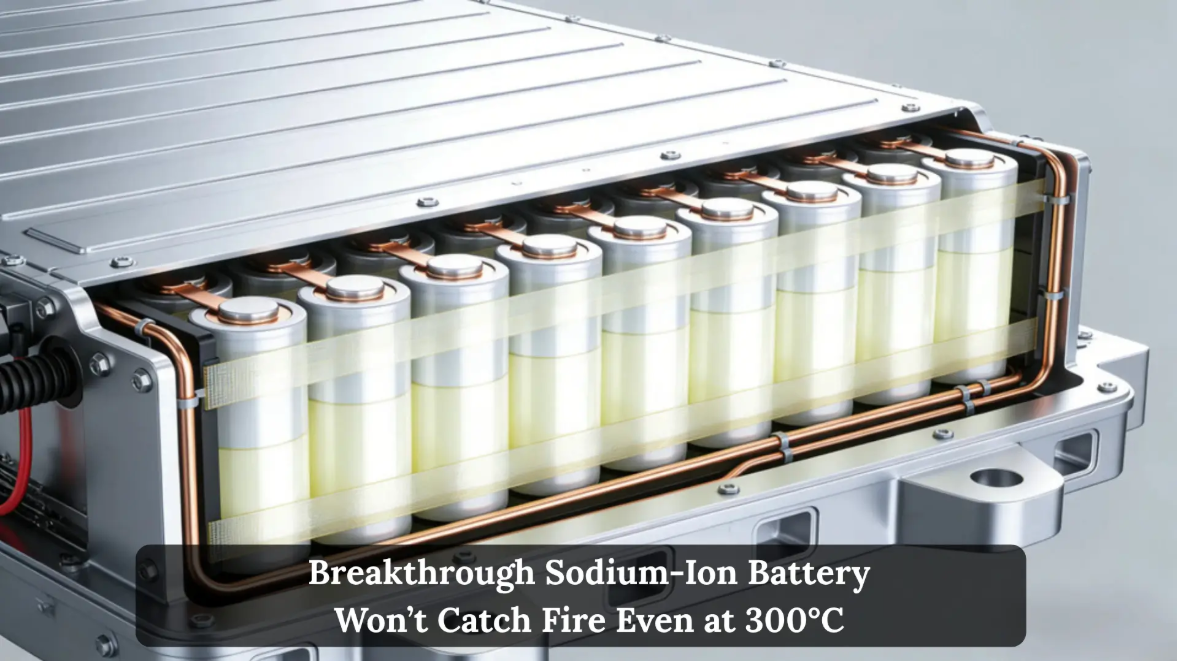
The article presents a major scientific advance in battery technology, describing a new sodium-ion battery that can remain safe even under extremely high temperatures. According to the page, researchers at the Chinese Academy of Sciences achieved this development and published their findings in Nature Energy. The article says the breakthrough is especially important because it addresses one of the most dangerous problems in modern battery systems: thermal runaway. By framing the discovery this way, the page immediately makes it clear that the story is not simply about a better battery. It is about solving a safety issue that has long limited public trust and industrial confidence in advanced energy storage systems.
The Safety Problem the Battery Is Trying to Solve
The article explains that thermal runaway is one of the biggest risks associated with traditional batteries, especially lithium-ion batteries. This happens when overheating triggers a chain reaction inside the battery, potentially leading to smoke, fire, or even explosion. The page argues that this danger is one of the main reasons battery safety remains such a serious concern in fields like electric vehicles and renewable-energy storage. What makes the reported breakthrough stand out, according to the article, is that it does not merely delay the danger. Instead, it claims to prevent thermal runaway altogether. That shift, if sustained in real-world conditions, would mark a major change in how battery safety is approached.
The Core Innovation Behind the Design
A central part of the article focuses on the battery’s electrolyte design. It says the research team, led by Hu Yongsheng at the Institute of Physics, created a polymerisable non-flammable electrolyte known as PNE. Unlike many existing systems that depend mainly on flame-retardant additives, this new approach is described as a multi-layer protection structure. The page says the electrolyte combines thermal stability, interface stability, and physical isolation into one integrated system. This matters because it suggests the safety mechanism is built into the battery’s structure rather than added as a secondary defense. The article uses this to support its broader claim that the battery is fundamentally safer by design.
How the Technology Works at High Heat
The article gives a fairly clear explanation of what happens when temperatures rise. It says that once the internal temperature exceeds 150°C, the electrolyte shifts from a liquid state into a solid state. This transformation creates an internal barrier that blocks heat transfer and prevents failure from spreading across the cell. In other words, even if part of the battery experiences severe stress or damage, the reaction is contained instead of cascading into a larger disaster. The page presents this as an important conceptual change in battery safety, because the aim is no longer just to slow ignition but to stop propagation before it can become uncontrollable.
Extreme Testing Results
To support the claims, the article points to testing on a 3.5Ah cylindrical sodium-ion cell. It says the battery was subjected to demanding safety checks, including nail-penetration testing, which is commonly used to simulate severe physical damage. According to the page, the battery produced no smoke, no fire, and no explosion, even under those conditions. More strikingly, it is said to have remained stable at temperatures as high as 300°C without entering thermal runaway. These results are what allow the article to use such strong language about the breakthrough. The testing section gives the story credibility within its own narrative because it shows that the claims were tied to direct performance under stress rather than only theoretical expectations.
Performance Without Sacrificing Usability
The page also makes an effort to show that safety was not achieved at the cost of performance. It says the battery works efficiently across a wide temperature range, from -40°C to 60°C, remains stable above 4.3V, and reaches an energy density of 211 Wh/kg at the cell level. That is an important part of the article’s message. A battery can be very safe, but if it performs poorly, industry adoption becomes unlikely. By including these figures, the article argues that this design offers both meaningful safety and practical usefulness. That combination is exactly what makes the report sound more significant than a laboratory curiosity.
Commercial and Industrial Potential
The article also connects the research to possible real-world deployment. It says the work is closely linked to Zhongke Haina, a sodium-ion battery developer that originated from the same institute. The page adds that industry reports suggest sodium-ion batteries are moving closer to commercial use, and it mentions promising testing in heavy trucks, including reduced energy use per kilometre and longer driving range under typical conditions. This section helps the article shift from lab science into market relevance. It suggests that the technology may not remain confined to research papers, but could soon influence transport and energy-storage industries where safety and cost matter deeply.
Conclusion
Overall, the article presents this sodium-ion battery breakthrough as a major step toward a safer future for energy storage. By preventing thermal runaway even under extreme heat, the design is portrayed as tackling one of the most serious weaknesses in current battery technology. The page strengthens that claim by emphasizing both test performance and commercial potential, arguing that the battery offers safety without sacrificing practical usefulness. In the article’s final impression, this is not just another battery improvement. It is the kind of development that could meaningfully reshape expectations around how advanced batteries are built, tested, and trusted.