
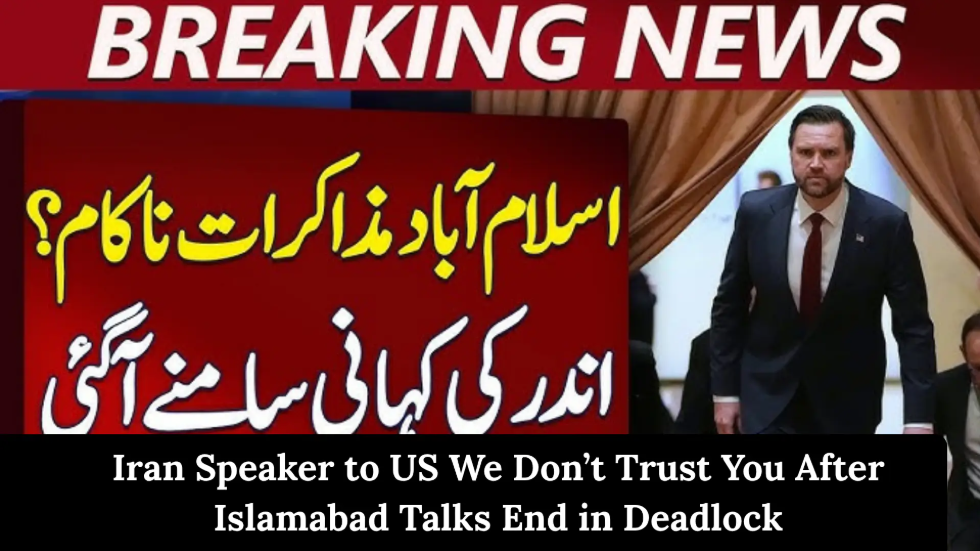
The linked news article presents the end of the Islamabad talks between Iran and the United States as a moment that revealed how deep the mistrust between the two countries still runs. According to the page, Mohammad Bagher Ghalibaf, Speaker of Iran’s Parliament, delivered a direct message after the negotiations, saying Tehran does not trust Washington even though it entered the dialogue in good faith. The article frames this statement as more than a rhetorical outburst. It treats it as a reflection of the wider political mood within Iran’s leadership, where suspicion toward American commitments remains deeply rooted.
The article says the negotiations in Islamabad had been viewed as an important opportunity to reduce tensions and reopen diplomatic space. Pakistan is presented as playing a facilitative role, while the talks themselves reportedly lasted 21 hours. Yet despite the length and seriousness of the discussion, the page says no concrete breakthrough was achieved. That failure is central to the article’s tone. It suggests that even when both sides remain engaged long enough for extended talks, the gap between them is still wide enough to block any meaningful agreement.
A major theme of the article is historical memory. It emphasizes that Iran’s reluctance to trust the United States is tied to a long legacy of conflict, diplomatic disappointment, and what Iranian leaders view as broken promises. The page says Ghalibaf pointed to past wars and failed commitments as reasons that Tehran remains cautious. This is important because the article is not portraying the distrust as a temporary mood created by one failed meeting. It is presenting distrust as part of the political framework through which Iran interprets every new negotiation.
At the same time, the source tries to show that Iran does not frame itself as unwilling to negotiate. Instead, it says Iranian negotiators arrived with what Ghalibaf described as goodwill and forward-looking proposals. The problem, according to the article, was that the American side did not provide assurances convincing enough to overcome Iran’s doubts. That distinction matters because it allows the article to depict Iran as open to diplomacy in principle while still being unconvinced in practice. In other words, the page presents Tehran’s position as cautious engagement rather than outright rejection.
The article also reflects the diplomatic symbolism of Islamabad as the setting. By hosting the talks, Pakistan is shown as a place where sensitive regional and international diplomacy can unfold. Yet the piece ultimately makes clear that venue alone cannot resolve decades of mistrust. A long negotiation in a neutral or helpful setting may create an opportunity, but it does not erase the political baggage that both parties bring into the room. That is one of the deeper messages running through the article, even though it is expressed through a straightforward news narrative.
In the end, the linked page presents the Islamabad talks as a reminder that diplomacy often struggles not because dialogue is absent, but because trust is missing. Ghalibaf’s statement becomes the article’s central takeaway: Iran may still participate in negotiations, but it does so without confidence that American promises will last. That makes the deadlock feel less like a temporary setback and more like evidence of a broader political reality. The article’s overall message is that until the trust gap narrows, even serious diplomatic efforts may continue to end with words rather than agreements.